Garage Door Repair: Repair or Replace? How Camden Homeowners Decide
Replacing a $90 spring on an 18-year-old door with a cracked bottom section, misaligned tracks, and a failing opener motor is the garage door equivalent of putting new tires on a car that needs an engine. The spring will outlast everything around it, and you’ll be back on the phone within a year. In our experience, the homeowners who make the best decisions aren’t the ones asking “how much is this fix?” They’re asking “what’s this door going to cost me over the next three failures?”
Here’s the short answer: repair the door when today’s failure is isolated and the rest of the system is sound. Replace it when you’re stacking repairs on a structure that’s already near the end of its working life. The rest of this piece is how to tell the difference in Camden without being pushed either way.
If you’d rather not climb around the door with a flashlight, call (877) 256-1677. Estimates are free, and we’ll tell you what we actually see.
Start With a Component Audit, Not a Repair Quote
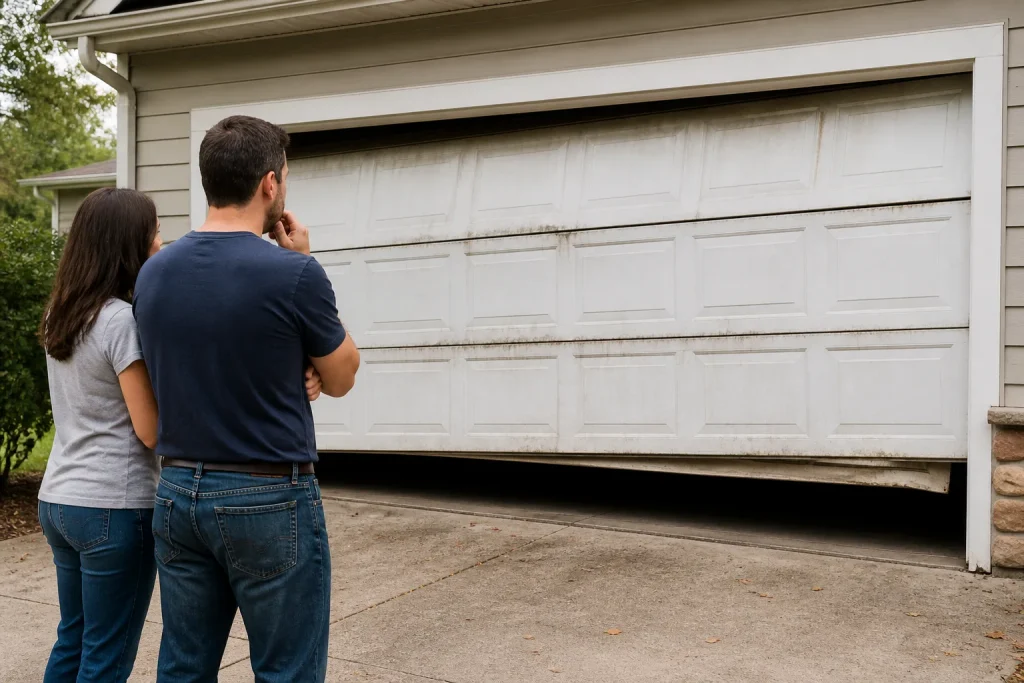
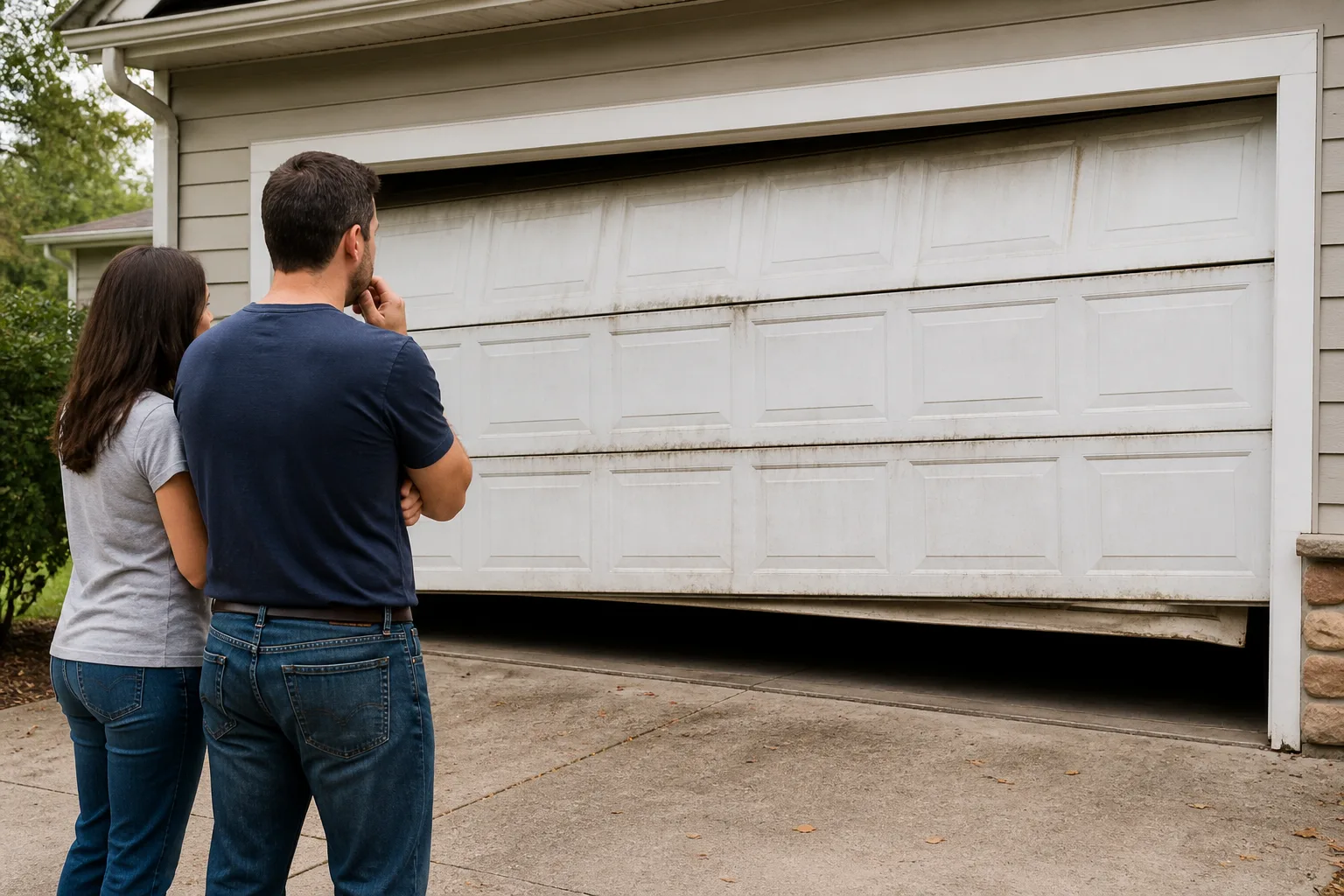
Before you accept any recommendation, walk around your door and look at it like a technician would. The goal is simple: figure out whether today’s breakdown is a one-off or the next entry on a growing list. A door that’s failing one part at a time is telling you something different than a door that dropped a single spring on an otherwise healthy system.
Work through these six checks on your Camden door:
- Springs. Two springs on an older torsion system usually have similar cycles on them. One breaks, the other is often close behind.
- Bottom seal and bottom section. Look for cracking rubber, rot at the panel edge, and water staining along the lowest panel.
- Panels. Run your hand down for dents, separation at the seams, and bowing in the middle of a section.
- Tracks. Stand inside and sight down each track. Kinks, dents, and any place where the track has pulled loose from the jamb matter.
- Hinges and rollers. Rusted hinges and flat-spotted rollers show up as a door that shudders or grinds through its travel.
- The opener. Old openers with chain drives, worn gears, or one that’s been repaired more than once are a signal on their own.
Write down what you find. A door with one problem is a repair. A door with four is a conversation. This audit is also your best defense against a recommendation that wasn’t based on your door at all.
The Cost-Per-Year Math That Actually Decides It
Most homeowners compare the price of the repair to the price of a new door and stop there. That comparison misleads, because it treats the next few years as free. A better method: estimate what you’ll spend on this door over the next three years, then add the replacement price you’d pay anyway at the end of that stretch.
Run the numbers like this:
- Add up what you’ve spent on repairs in the last two or three years.
- Estimate the next likely failure. On an aging door that’s usually the second spring, then an opener.
- Add any cosmetic work you’d want (a repainted or replaced bottom section is common in Camden).
- Divide that total by the years it buys you. If the per-year figure creeps toward what a new door costs divided by its service life, replacement starts to win.
The principle is straightforward: repairs are worth it while the door still has plenty of life left to spread the cost over. Once you’re spending real money every year just to keep the same door moving, you’re paying replacement prices in installments and keeping the old door. When we run this math with homeowners, we say the numbers out loud so they can decide with a clear picture, not a sales pitch.
Which Failures Are Almost Always Worth Repairing?
Some breakdowns are isolated events. They happen to doors of every age and say nothing about the door’s overall condition. Repairing these is the right call on a 25-year-old door as often as it is on a new one.
- A single spring on a matched pair. This is the exception that proves the rule. Springs are wear parts, and when one goes, the pair usually gets replaced together. That’s a repair on a system that’s otherwise fine, not a sign the door is finished.
- One bent track. A single section of track that got bumped is a repair. Tracks that are bent in several places and pulling away from the jamb are a different story.
- An opener that’s simply old but working. If the door itself is sound, replacing the opener is far cheaper than a new door and opener together.
- A snapped cable. Cables are wear items on a door with good panels and straight tracks.
- Rollers and hinges. These are cheap, they wear out, and replacing them can quietly buy years.
Notice the pattern: the repair list is about parts that wear, not parts that hold the door together. The moment you’re repairing structure, the calculation changes. That’s the framework we use on every Camden garage door repair call before we quote anything.
Which Failures Signal the Door Is Near End of Life?
Other failures point at the door as a whole. They’re the ones where a repair is money spent to get a few more months out of a structure that’s already tired. Three or more at once on the same door is a strong case for replacement.
- Cracked or rotted bottom sections. The bottom panel takes the worst of Minnesota weather, and once it’s failing, water gets behind it and the problem spreads upward.
- Multiple panels with separation or bowing. Panels that have come apart at the seams can’t be made whole again with hardware.
- Tracks that are bent in more than one place. When the track geometry is off across the door, you’re fighting the whole system every time it moves.
- A door that needs a new spring, new opener, and new bottom section. At that point you’re replacing most of the moving parts and the weather surface on an old chassis.
- Failing hardware on top of failing panels. Hinges popping loose from rotted wood are the clue that the structure itself is giving up.
None of these means a door can’t be kept running. It means the money is going into a door that’s already at the end of its service life, and the next failure is usually not far behind.
How Minnesota Weather Shifts the Calculation in Camden
The climate in Camden pushes on specific parts of a door harder than in milder parts of the country, and that changes what a repair actually buys you.
- Wood bottom sections. Snow, ice, and freeze-thaw cycles at the floor line are relentless. A wood bottom panel that’s already showing rot tends to keep failing, panel after panel, unless the door gets a proper weather seal.
- Metal and torsion hardware. The freeze-thaw swing works on springs and steel the same way it works on pavement. Repeated expansion and contraction shortens the life of both.
- Spring metal fatigue. Springs are rated in cycles, and a door that cycles more often in cold weather wears its springs faster than a door in a warmer climate would. That changes how long a fresh spring lasts, and it changes what a repair is really buying.
- Seals and weatherstripping. Rubber and vinyl harden and crack faster in a hard winter, and once the seal fails, the bottom panel is next.
What this means for the decision: on a wooden door in Camden, a repair to the bottom of the door is a running fix unless the whole assembly is sound. On a steel door with a solid bottom section, the same repair often holds for years.
How to Vet a Recommendation Before You Accept It
Any technician who walks up to a door has a recommendation forming within a minute. Your job is to make sure the recommendation is based on the door’s condition and not on which answer generates more revenue. Ask questions that force the answer to be about your door.
Good questions to ask:
- What did you find, and which parts are worn versus broken?
- Is today’s failure isolated, or is it part of a pattern with the rest of the system?
- What are the next three things likely to fail, and roughly when?
- If we repair it today, what’s the realistic lifespan of the rest of the door?
- What would you do if it were your door?
You should also be able to hear the reasoning, not just the verdict. A technician who can explain why a repair makes sense on your door, and why replacement doesn’t (or the reverse), is giving you a recommendation you can act on. The brand on the door shouldn’t matter either. Whether it’s Wayne Dalton, Craftsman, Raynor, or LiftMaster, the condition of the door is what drives the answer, and a recommendation shouldn’t change because of which panels happened to be in stock. We work on whatever system is in your garage, so we’ve got no reason to steer you toward one brand over another.
When a technician recommends replacement, it’s fair to ask why a repair won’t do. When a technician recommends a repair, it’s fair to ask what’s next in line to fail. The answers tell you more than the price does.
When to Call a Pro
Some of this audit is safely done with a flashlight. Some of it absolutely is not. Torsion springs under tension and cables running through them can cause serious injury if you try to work on them, and no homeowner should. Leave anything involving spring tension or the cable system to a trained technician. If a door won’t open at all, or the opener is making noises you don’t recognize, that’s the moment to call rather than reason about it.
We offer emergency service for urgent situations, and we handle both the door’s mechanical system and the opener electronics. If you’re in Camden and need help now, call (877) 256-1677. Our technicians have up to 10 years of experience with spring repair, opener work, and full door installation.
Related services in Camden:
The Bottom Line
Repair when today’s failure is isolated and the rest of the door has life left in it. Replace when you’re already on a first-name basis with the repair technician and the failures keep coming from the same tired structure. The cheapest answer in the moment isn’t always the cheapest over time, and the more expensive answer isn’t automatically the right one either.
- Run the component audit first. It’s free and it tells you whether the door is failing one part at a time.
- Do the cost-per-year math over a three-year window, not just the price of today’s repair.
- Repair isolated wear parts. Replace when the failures point at the structure of the door.
- Ask the technician to explain their reasoning, and don’t accept a recommendation that would be the same on any other door.
If you’re in Camden and need help, Garage Door Repair Camden offers free estimates. Call (877) 256-1677, and we’ll walk the door with you and give you a straight answer on what’s worth repairing and what isn’t.
Frequently Asked Questions
How do I know if my garage door needs repair or replacement? Repair it if today’s failure is an isolated wear part like a spring, cable, roller, or single track section on an otherwise sound door. Replace it if the failures are structural, or if you’re stacking repairs on three or more parts of a door that’s already near the end of its working life. Call (877) 256-1677 for a free estimate if you’re unsure.
Should I replace both springs or just the broken one? Replace them as a matched pair. On most torsion systems, the springs have cycled the same number of times, and once one breaks the other is typically close behind. Replacing a single spring usually means a second service call before long. Call (877) 256-1677 for pricing.
Is it worth repairing an older garage door in Camden? It depends on the condition of the whole assembly. On a steel door with sound panels, straight tracks, and a working opener, a repair is often worth it regardless of the door’s age. On a wood door with rot in the bottom section and failing panels, repair money tends to go into a door that keeps failing. Call (877) 256-1677 and we’ll tell you which you’re looking at.
Will a technician recommend replacement just to sell me a new door? The good ones won’t. Ask what’s worn versus broken, what’s likely to fail next, and what they’d do if it were their own door. Whether it’s a Wayne Dalton, Craftsman, Raynor, or LiftMaster door, the recommendation should be based on its condition, not on which panels are available. Call (877) 256-1677 for an honest read on your door.
Written by the team at Garage Door Repair Camden.
Need Garage Door Help?
Call Garage Door Repair Camden - the local pro we connect you with is licensed and insured, here with fast after-hours help in Camden.
(877) 256-1677